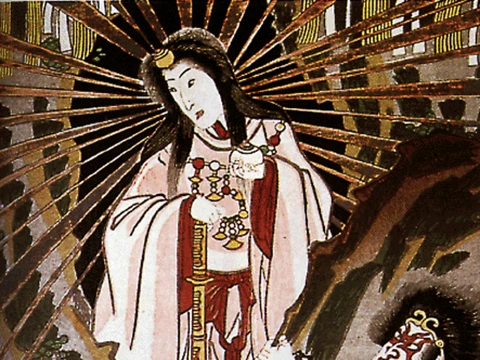
Daidarabotchi
Giant yōkai whose footprints formed lakes and weighed mountains.
Daidarabotchi (ダイダラボッチ, 大座法師) is a giant yōkai from Japanese folklore, often described as so enormous that it could be mistaken for a mountain range while asleep. Its footprints were said to form countless lakes and ponds. One legend tells of a Daidarabotchi that weighed Mount Fuji and Mount Tsukuba to compare them, but accidentally broke off Tsukuba’s peak in the process.
The 8th-century *Hitachi no Kuni Fudoki* records a Daidarabotchi living on a hill west of the Hiratsu Ogushi post office, where it fed on giant clams from the beach and piled the shells on a hilltop. In Ibaraki Prefecture, the creature was seen as benevolent, moving mountains to help local people. In Mito, a 15-meter statue of the yōkai stands in Ogushi Kaizuka Park. The *Izumo no Kuni Fudoki* also mentions a giant-like figure: Ōmitsunu, a demi-god and grandson of Susanoo, who used his strength to pull land from Silla with ropes, expanding his territory. Additionally, Daidarabotchi was said to dwell at Mount Togakushi, where a pond on its south side bears its name.
- type
- Yōkai
- mythology
- Japanese
- known_for
- Gigantic size, creating lakes from footprints, weighing Mount Fuji and Mount Tsukuba
- region
- Hitachi Province, Ibaraki Prefecture, Izumo, Mount Togakushi
Lore & Background
The size of a Daidarabotchi was so great that his footprints were said to have created innumerable lakes and ponds. In one legend, a Daidarabotchi weighed Mount Fuji and Mount Tsukuba to see which was heavier, but he accidentally split Tsukuba's peak after he was finished with it.
The Hitachi no Kuni Fudoki, a recording of the imperial customs in the Hitachi Province compiled in the 8th century, also told of a Daidarabotchi living on a hill west of a post office of Hiratsu Ogushi who fed on giant clams from the beach, piling the shells on top of a hill. In the larger Ibaraki Prefecture, Daidarabotchi was considered a benevolent giant, moving mountains to aid the people of Ibaraki. In Mito, Ibaraki, a 15-meter statue was erected in Ogushi Kaizuka Park to commemorate the yōkai and its myths.
Izumo no Kuni Fudoki also mentions a legendary king of Izumo, Ōmitsunu, who was the grandson of Susanoo and a demi-god. Having the strength of a giant, he performed Kuni-biki, pulling land from Silla with ropes, to increase the size of his territory. The Daidarabotchi was also said to reside at Mount Togakushi, where there exists a pond on its south side bearing its name.
Reader's Guide
Daidarabotchi holds significance in Japanese mythology as a primordial giant whose actions shaped the landscape. Its footprints are credited with forming countless lakes and ponds, and its legendary weighing of Mount Fuji and Mount Tsukuba explains the latter's broken peak. The creature appears in the 8th-century Hitachi no Kuni Fudoki, where it is depicted as a giant feeding on clams and piling shells on a hill, linking it to local geography. In Ibaraki Prefecture, Daidarabotchi is remembered as a benevolent figure that moved mountains to help people, a legacy commemorated by a 15-meter statue in Mito. The Izumo no Kuni Fudoki associates a similar giant, Ōmitsunu, with land-pulling from Silla, though the article does not explicitly equate him with Daidarabotchi. The yōkai's residence at Mount Togakushi, marked by a pond bearing its name, further roots it in specific locations. As a mythological figure, Daidarabotchi embodies the power of nature and the human attempt to explain geological features through storytelling. Its dual nature—sometimes a sleeping mountain range, sometimes an active shaper of land—reflects the ambiguity of yōkai in Japanese folklore. The statue in Ogushi Kaizuka Park demonstrates ongoing cultural recognition, while the legends preserved in the Fudoki show its ancient origins. Daidarabotchi's legacy endures as a symbol of the vast, creative forces that myth attributes to the natural world.
Did You Know?
- Daidarabotchi's footprints were said to have created innumerable lakes and ponds.
- In one legend, a Daidarabotchi accidentally split Mount Tsukuba's peak after weighing it against Mount Fuji.
- A 15-meter statue of Daidarabotchi was erected in Ogushi Kaizuka Park in Mito, Ibaraki.
- The Hitachi no Kuni Fudoki tells of a Daidarabotchi that fed on giant clams and piled their shells on a hill.
More in Japanese folklore 1-24
Spotted an error? Know more?
This is a living reference — every entry is fact-audited, and reader corrections feed straight into our audit queue. Suggest an edit · See this site's audit record