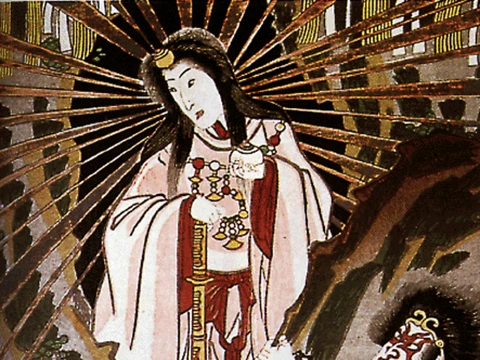
Abe no Seimei
Heian-era onmyōji and legendary figure in Japanese folklore.

Wikipedia / Wikimedia Commons
Abe no Seimei (born 921 – died 1005) served as an onmyōji—a court official and master of Onmyōdō—during the Heian period. He is both a historical figure and a legendary presence in Japanese folklore, appearing in numerous stories and films. His work for emperors and the Heian government involved advising on spiritually correct solutions to problems, praying for the well-being of the court, and offering guidance on various issues. He also practiced astrology, predicting celestial events. Kyoto’s Seimei Shrine is dedicated to him, and the Abeno station and district in Osaka bear his name, as legend places his birth there.
His life is well-documented, leaving little doubt about his existence, but legends arose soon after his death, much like those surrounding Merlin. Many of these tales first appeared in the *Konjaku Monogatarishū*, and by the Edo period, stories of his heroic deeds were widespread. His ancestry is unclear; a traditional association links him to the poet Abe no Nakamaro, though this is not confirmed by reliable historical evidence. According to one source, he was a disciple of Kamo no Tadayuki and Kamo no Yasunori, succeeding Yasunori in astrology and divination while Yasunori’s son handled calendar-making. His duties included analyzing strange events, performing exorcisms, warding off evil spirits, and conducting geomancy rites. He was reputedly skilled at divining the sex of fetuses and finding lost objects. The *Konjaku Monogatarishu* records that he correctly predicted Emperor Kazan’s abdication by observing celestial signs. From the late 10th century, the Abe clan controlled the Onmyōryō, the government ministry of Onmyōdō, while the Kamo clan became hereditary calendar keepers.
The five-pointed star known in the West as a pentagram is called the Seiman, the Seal of Abe no Seimei, or the Seimei Kikyō in Japan. Originally his personal seal, it later became the symbol of the Onmyōryō and of Onmyōdō itself, tied to the Chinese Five Elements. Legend holds that Seimei was not fully human: his father, Abe no Yasuna, was human, but his mother, Kuzunoha, was a fox spirit. His mother entrusted him to Kamo no Tadayuki so he would live a good human life and not turn evil. Many tales from
- born
- 921 AD (exact day and month not historically recorded)
- died
- 1005 (exact day and month not historically documented)
- field
- Onmyōdō (astrology, divination, exorcism)
- nationality
- Japanese
- known_for
- Legendary onmyōji; advisor to Heian emperors; associated with the pentagram seal (Seiman); subject of folklore and modern media
Lore & Background
Abe no Seimei's life is well-recorded, but legends arose immediately after his death, many recorded in the Konjaku Monogatarishū. His ancestry is unclear; a traditional association links him to the poet Abe no Nakamaro, though this is not confirmed by reliable historical evidence. Some sources name him Abe-no-Sukune-no-Seimei, others Abe-no-Asomi-no-Seimei. He was a disciple of Kamo no Tadayuki and Kamo no Yasunori, becoming Yasunori's successor in astrology and divination. His duties included analyzing strange events, exorcisms, warding against evil spirits, and geomancy. He was said to be skilled in divining the sex of fetuses and finding lost objects, and correctly predicted Emperor Kazan's abdication based on celestial phenomena.
According to legend, Seimei was no
Reader's Guide
Abe no Seimei's significance lies in his historical role as a leading onmyōji of the Heian court and his enduring legacy in Japanese culture. After his death, Emperor Ichijo ordered a shrine built at his home in 1007 AD; the Seimei Shrine in Kyoto, though destroyed in the 15th century, was rebuilt and still stands, attracting fans of his popular culture portrayals. The pentagram symbol known as the Seiman or Seimei Kikyō, originally his personal seal, became the symbol for the Onmyōryō and Onmyōdō itself. The asteroid 5541 Seimei is named for him. In modern times, his story inspired novels, manga, films, and even a figure skating program by Yuzuru Hanyu, who portrayed Seimei in his Olympic free skate. The 1985 novel Teito Monogatari revived widespread interest in Onmyōdō, and Baku Yumemakura's Onmyōji novel series (1988) further popularized Seimei as a handsome young man. He has been termed 'the Merlin the Magician of Japan' by some scholars due to his legendary status and the cambion-like origin story shared with Merlin.
Did You Know?
- Abe no Seimei lived 84 years free from any major illness, contributing to beliefs in his mystical powers.
- The pentagram symbol known as the Seiman was originally Abe no Seimei's personal seal and later became the symbol for Onmyōdō.
- According to legend, his mother Kuzunoha was a kitsune (fox spirit), making him part fox.
- The asteroid 5541 Seimei, discovered in 1976, is named for him.
More in Japanese folklore 1-24
Spotted an error? Know more?
This is a living reference — every entry is fact-audited, and reader corrections feed straight into our audit queue. Suggest an edit · See this site's audit record