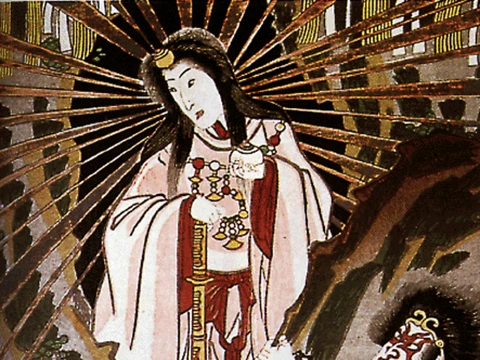
Chūjō-hime
Japanese folk heroine and nun, weaver of the Taima Mandala.
Chūjō-hime (also written Chūjō Hime or Hase-Hime) was a daughter of the court noble Fujiwara no Toyonari, who lived circa 753–781. According to most accounts, she escaped persecution by her stepmother by becoming a nun at Taima-dera in Nara, taking the name Zenshin-ni or the Dharma name Honyo. She is a folk heroine celebrated in Japanese folktales for her filial piety and is sometimes called the Japanese Cinderella.
- born
- c. 753?
- died
- 781?
- field
- Buddhist nun, folk heroine
- nationality
- Japanese
- known_for
- Weaving the Taima Mandala; filial piety; subject of folktales
Lore & Background
Chūjō-hime is said to be the daughter of an imperial minister of the Fujiwara clan and a royal princess. Most accounts place her birth in the 8th century during Emperor Shōmu's reign and identify her father as Fujiwara no Toyonari, though a few state she was the daughter of Fujiwara no Toyoshige a century earlier. According to legend, her childless parents appealed to Kannon and were granted a daughter in exchange for the life of one parent; when Chūjō-hime was three, her mother died, and her father remarried. In some versions, her stepmother ordered her taken into the mountains and abandoned; in others, she remained home copying Buddhist sutras for her mother's salvation, earning her stepmother's enmity. In either case, she was rescued by Buddhist nuns of Taima-dera and became a nun herself, living an austere and meditative life and becoming known as a 'living Buddha.' She is credited with inventing the art of embroidery.
Reader's Guide
Chūjō-hime's significance lies in her transformation from a persecuted noble daughter into a revered Buddhist nun and folk heroine. Her legend, first recorded in the 13th-century handscroll Taima Mandara engi emaki, centers on her weaving of the Taima Mandala, a depiction of the Pure Land's cosmography, which she is said to have completed in a single night with divine aid. Over time, her story was elaborated in Nō plays such as Hibariyama and Taema, which added details about her life before becoming a nun, including abandonment on Mount Hibari and reunion with her father. Traveling monks and nuns used her tale to spread Buddhist teachings, especially emphasizing female salvation. Her relics, including statues and handscrolls, traveled across the Yamato region, and her image was later used to market the gynecological medicine Chūjōtō. She remains a symbol of filial piety and devotion in Japanese culture.
Did You Know?
- Chūjō-hime is sometimes called the Japanese Cinderella.
- She is credited with inventing the art of embroidery.
- The Taima Mandala she wove is said to have been completed in a single night with help from an apparition of Amida Butsu.
- Her story was used in the late Muromachi period to popularize the gynecological medicine Chūjōtō.
More in Japanese folklore 1-24
Spotted an error? Know more?
This is a living reference — every entry is fact-audited, and reader corrections feed straight into our audit queue. Suggest an edit · See this site's audit record