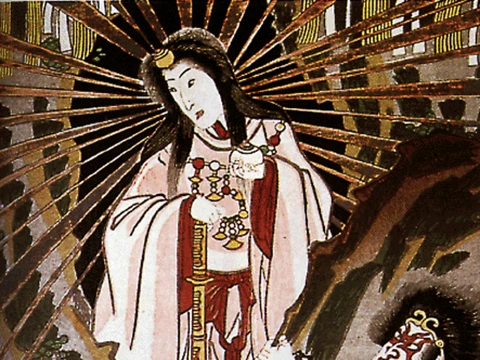
Banchō Sarayashiki
A Japanese ghost story of a servant who returns to count plates.

Wikipedia / Wikimedia Commons
Banchō Sarayashiki (番町皿屋敷), also known as The Dish Mansion at Banchō, is a Japanese ghost story about trust broken and promises betrayed, ending in tragedy. This tale, sometimes called the sarayashiki (Manor of the Dishes) tradition, always centers on a servant who is killed unjustly and later returns to haunt the living. The setting varies: some versions take place in Harima Province or Banshū, while others are set in the Banchō district of Edo.
The story of the servant Okiku first appeared as a bunraku play in July 1741 at the Toyotakeza theater. This puppet drama was adapted by Asada Iccho and Tamenaga Tarobei I. A kabuki version soon followed, staged in September 1824 at the Naka no Shibai theater, with Otani Tomoemon II and Arashi Koroku IV playing Aoyama Daihachi and Okiku. In 1850, Segawa Joko III created a one-act kabuki version titled Minoriyoshi Kogane no Kikuzuki, which premiered at the Nakamura-za theater starring Ichikawa Danjūrō VIII and Ichikawa Kodanji IV as Tetsuzan and Okiku. This adaptation was unpopular and quickly closed, but it was revived in June 1971 at the Shinbashi Enbujō theater, featuring Kataoka Takao and Bando Tamasaburō V in the same roles. The most familiar version, written by Okamoto Kido, debuted in February 1916 at the Hongō-za theater, with Ichikawa Sadanji II and Ichikawa Shōchō II as Lord Harima and Okiku. This modern adaptation replaced horror with a psychological study of the two characters' motivations.
In the folk version, a beautiful dishwashing servant named Okiku works at Himeji Castle. Her master repeatedly tries to make her his lover, but she refuses. Growing impatient, he hides one of ten precious dishes she is responsible for. When he calls her, he claims a plate is missing. Frantic, she counts and recounts the nine plates many times. The samurai offers to overlook the loss if she becomes his lover, but she refuses again. Enraged, he has his servants beat her, tie her up, and suspend her above a well. He tortures her, again demanding marriage, then slashes her with his sword and drops her body into the well. Okiku becomes a vengeful spirit (onryō) who torments her murderer by counting to nine and then making a terrible shriek for the missing tenth plate—or perhaps she torments herself, still searching for the plate but crying out in agony when she cannot find it. In some versions, this continues until an exo
- First appearance
- July 1741
- Medium
- Bunraku, kabuki, folk tale
- Origin
- Japan
- Known for
- Ghost of Okiku counting plates
- Notable adaptations
- Okamoto Kido version (1916)
Lore & Background
The story of the death of Okiku (お菊) first appeared as a bunraku play called Banchō Sarayashiki in July 1741 at the Toyotakeza theater. The familiar ghost legend had been adapted into a ningyō jōruri production by Asada Iccho and Tamenaga Tarobei I. Like many successful bunraku shows, a kabuki version followed and in September 1824, Banchō Sarayashiki was staged at the Naka no Shibai theater starring Otani Tomoemon II and Arashi Koroku IV in the roles of Aoyama Daihachi and Okiku.
A one-act kabuki version was created in 1850 by Segawa Joko III, under the title Minoriyoshi Kogane no Kikuzuki, which debuted at the Nakamura-za theater and starred Ichikawa Danjūrō VIII and Ichikawa Kodanji IV in the roles of Tetsuzan and Okiku. This one-act adaptation was not popular, and quickly folded, until it was revived in June 1971 at the Shinbashi Enbujō theater, starring the popular combination of Kataoka Takao and Bando Tamasaburō V in the roles of Tetsuzan and Okiku.
The most familiar and popular adaptation of Banchō Sarayashiki, written by Okamoto Kido, debuted in February 1916 at the Hongō-za theater, starring Ichikawa Sadanji II and Ichikawa Shōchō II in the roles of Lord Harima and Okiku. It was a modern version of the classic ghost story in which the horror tale was replaced by a psychological study of the two characters' motivations.
Reader's Guide
Banchō Sarayashiki is a foundational kaidan that has shaped Japanese ghost lore and theater. Its core narrative—a servant wrongfully killed who returns as a vengeful spirit counting plates—appears in multiple versions, from folk tales set in Himeji Castle to bunraku and kabuki plays. The story's adaptability is evident in its variations: in some, Okiku is a maid who incurs her mistress' jealousy; in others, she is a lady-in-waiting caught in a political plot. The 1916 Okamoto Kido version marked a shift toward psychological and romantic elements, influenced by Western plays brought during the Meiji Restoration, and remains a classic of Shin Kabuki. The tale's cultural impact extends beyond theater: in 1795, well larvae were called 'Okiku insect' (お菊虫, okiku mushi), and Himeji Castle features Okiku-Ido (Okiku's Well), where her ghost is said to rise nightly. The story has also been parodied in manga like Rumiko Takahashi's Maison Ikkoku and adapted in the manga Akane-banashi as a comedic rakugo performance. Ukiyo-e artists such as Katsushika Hokusai and Tsukioka Yoshitoshi depicted Okiku, with Yoshitoshi's portrayal noted as unusually sympathetic.
Did You Know?
- The story first appeared as a bunraku play in July 1741 at the Toyotakeza theater.
- In 1795, well larvae in Japan were called 'Okiku insect' (お菊虫, okiku mushi) because they looked bound with thin threads.
- Himeji Castle has a well called Okiku-Ido, where her ghost is said to rise nightly and count to nine before shrieking.
- Manga artist Rumiko Takahashi included a parody of the legend in her romantic comedy Maison Ikkoku.
More in Japanese folklore 1-24
Spotted an error? Know more?
This is a living reference — every entry is fact-audited, and reader corrections feed straight into our audit queue. Suggest an edit · See this site's audit record