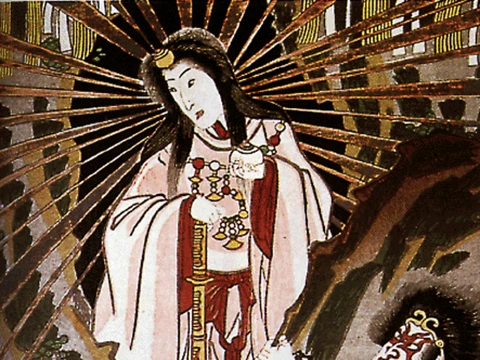
Arahitogami
Japanese term for a human being who is a kami.

Wikipedia / Wikimedia Commons
Arahitogami (現人神) is a Japanese word for a human being who is also a kami (a deity). The term first appeared around 720 in the *Nihon Shoki*, where the legendary prince Yamato Takeru declares, "I am the son of an arahitogami." In Shinto practice, it is not unusual for a person to be venerated as a god, particularly after death—figures such as Sugawara no Michizane and Tokugawa Ieyasu are examples. The concept also connects to the Chinese tradition of worshiping living people.
In 1946, under pressure from the Allied occupation (GHQ), Emperor Hirohito issued the Humanity Declaration. In it, he stated that he had never been an *akitsumikami* (現御神), often translated as a "manifest kami" or "incarnation of a god." He insisted his bond with the people was based on historical, family-like trust, not on mythological ideas. Notably, the declaration avoided the word *arahitogami*. Some Western scholars, including John W. Dower and Herbert P. Bix, have argued that by renouncing only the status of *akitsumikami*, the emperor could still be considered an *arahitogami*—a living god, though not a manifest one. Jean Herbert adds that in Japanese tradition, the emperor is seen as "the extension in time" of the goddess Amaterasu and earlier emperors, occupying a *naka ima* (中今), making a denial of divine origin inadmissible.
- field
- Japanese religious and political terminology
- known_for
- Designating a human being as a living deity; associated with the emperor and posthumous deification
- first_appearance
- Nihon Shoki (c. 720)
- related_concept
- Akitsumikami (manifest kami)
Lore & Background
The term arahitogami first appears in the Nihon Shoki (c. 720) as the words of Yamato Takeru saying: 'I am the son of an arahitogami.' In Shinto, it is somewhat common for a person to be revered as a god, especially after they have died. Examples include Sugawara no Michizane and Tokugawa Ieyasu. The concept is also linked to the Chinese concept of worship of the living.
Reader's Guide
The significance of arahitogami lies in its role in Japanese imperial ideology and Shinto practice. In 1946, at the request of the GHQ, the Shōwa Emperor (Hirohito) proclaimed in the Humanity Declaration that he had never been an akitsumikami (divinity in human form), and claimed his relation to the people did not rely on such a mythological idea but on a historically developed family-like reliance. However, the declaration excluded the word arahitogami. Some Western scholars, including John W. Dower and Herbert P. Bix, explained that akitsumikami means 'manifest kami' (or 'incarnation of a god'), and that therefore the emperor would still be, according to the declaration, an arahitogami ('living god'), although not an akitsumikami. Jean Herbert explains that, according to Japanese tradition, the figure of the emperor would be 'the extension in time' of the goddess Amaterasu and the previous emperors, representing a naka ima, and consequently it would be inadmissible to deny its divine origin. The term thus remains a point of scholarly debate regarding the emperor's status.
Did You Know?
- The word arahitogami first appears in the Nihon Shoki (c. 720) in the words of Yamato Takeru.
- In 1946, the Shōwa Emperor's Humanity Declaration excluded the word arahitogami.
- Examples of people revered as gods in Shinto include Sugawara no Michizane and Tokugawa Ieyasu.
- Some Western scholars argue that the emperor remained an arahitogami even after the Humanity Declaration.
More in Japanese folklore 1-24
Spotted an error? Know more?
This is a living reference — every entry is fact-audited, and reader corrections feed straight into our audit queue. Suggest an edit · See this site's audit record