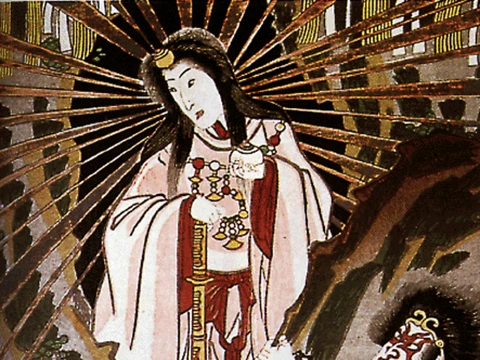
Atmospheric ghost lights
Unexplained lights in the atmosphere, often linked to folklore.

Wikipedia / Wikimedia Commons
Atmospheric ghost lights are unexplained luminous phenomena—either flames or glowing orbs—that appear in the sky. Well-known examples include the onibi, hitodama, and will-o'-the-wisp, and they are most frequently reported in humid regions.
Folklore often interprets these lights as the restless spirits of the dead, the mischief of fairies, or the work of devils or yōkai. Some people view them as omens of death. Elsewhere, folk traditions hold that such fires mark buried treasure, representing either the spirit of the treasure itself or the souls of people interred with grave goods. There is also a modern tendency to link atmospheric ghost lights with UFO sightings.
Some cases, like St. Elmo's fire or the shiranui, have been scientifically explained as optical effects caused by electrical activity in the atmosphere. Other possible explanations include the combustion of flammable gases, ball lightning, meteors, human-made fires (such as torches), misidentified human objects, and deliberate hoaxes.
**Australia** The Min Min light is a phenomenon reported in the Australian outback. Its origins predate European colonization, but it has since become part of contemporary urban folklore.
**Canada** The St. Louis light is a mysterious white beam of light seen near St. Louis, Saskatchewan.
**Japan** Beyond the onibi and hitodama, Japanese legend includes other ghost lights such as the kitsunebi and shiranui:
- **Osabi** (meaning "loom-guide fire"): In the Nobeoka area of Miyazaki Prefecture, first-hand accounts described two balls of fire appearing side by side on rainy nights at Misuma Pond until the mid-Meiji period. The story goes that a woman lent a loom guide (an osa) to another woman; when she returned to reclaim it, they argued and both fell into the pond. Their quarrel became an eternal ghost fire, and legend warns that anyone who sees it will meet misfortune.
- **Obora**: On Ōmi Island in Ehime Prefecture, this is said to be the spirit fire of a deceased person. In the village of Miyakubo (now part of Imabari), it is called oborabi. Similar fires are said to appear above the sea or at graves.
- **Kane no Kami no Hi** ("fire of the metal god"): On Nuwa Island, Ehime Prefecture, this fire appears on New Year's Eve behind the local Shinto shrine. It is accompanied by sounds like human screaming and is taken by residents as a sign that the goddess o
- type
- Atmospheric phenomenon
- also_known_as
- Ghost lights, will-o'-wisp, onibi, hitodama
- common_locations
- Worldwide, including Australia, Canada, Japan, Norway, United Kingdom, United States
- reported_explanations
- Optical phenomena, electrical activity, combustion of flammable gases, ball lightning, meteors, human-made fires, misperception, pranks
- notable_examples
- Min Min light, St. Louis light, Hessdalen lights, Longdendale lights, Spooklight, Marfa lights, Brown Mountain lights, Gurdon light
Lore & Background
Atmospheric ghost lights appear in legends worldwide. In Japan, numerous named varieties exist, such as the osabi, obora, kane no kami no hi, kinka, kumobi, gongorōbi, jōsenbi, sōrikanko, susuke chōchin, and nobi. Many are tied to local tragedies: the osabi, for instance, is said to be the ghost of two women who argued and fell into a pond, and misfortune befalls anyone who sees it. The gongorōbi is the ghost of a murdered gambler, and its appearance signals impending rain. The sōrikanko is the spirit of a girl buried alive by a rejected suitor.
Reader's Guide
Atmospheric ghost lights have been a persistent element of folklore across cultures, often serving as omens of death, treasure, or supernatural presence. While many remain unexplained in legend, some have been scientifically accounted for: St. Elmo's fire and the shiranui are optical phenomena from electrical activity, and other types may result from burning gases, ball lightning, meteors, or human-made sources. In the United States, the Spooklight and Paulding Light were both found to be caused by distant car headlights. Despite such explanations, the lights continue to capture the imagination, with modern reports like the Hessdalen lights in Norway and the Min Min light in Australia becoming part of contemporary urban folklore. Their persistence across time and geography underscores a human tendency to seek meaning in the unexplained, blending observation, fear, and storytelling.
Did You Know?
- The osabi in Japan is said to be the ghost of two women who argued and fell into a pond, and misfortune befalls anyone who sees it.
- The Spooklight in Missouri and the Paulding Light in Michigan were scientifically explained as distant car headlights.
- In Norway, the Hessdalen lights have been reported since at least the 1930s.
- Some ghost lights like St. Elmo's fire are explained as optical phenomena from electrical activity.
More in Japanese folklore 1-24
Spotted an error? Know more?
This is a living reference — every entry is fact-audited, and reader corrections feed straight into our audit queue. Suggest an edit · See this site's audit record